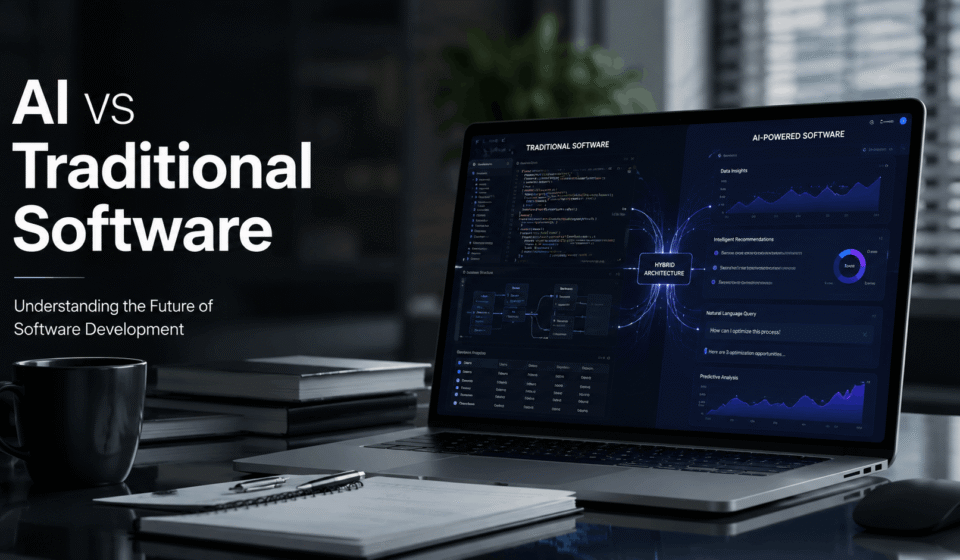

AI will not replace traditional software entirely in the next decade. Rather, the new software experiences will be AI-delivered, while the standards-based modules that run on traditional code will be virtually indispensable for anything large, predictable, safe, regulated, or mission critical. A hybrid model will win; traditional code delivering control and consistency, AI delivering automation, intelligence, personalization, and flexibility.
We are witnessing a significant transformation of software. For years, developers have been creating applications by manually outlining every rule, workflow, and parameter, as well as defining the business logic, inputs, and outputs. Now, artificial intelligence can produce code, understand in plain language, sift through huge data masses, perform predictions, and execute much work that previously required programming.
It is now a strategic question companies need to address when developing their products, to modernize legacy infrastructure, to hire developers and to invest in technology. That‘s makes AI vs traditional software more than a technology comparison.
It is unlikely that a simple winner will emerge in the next decade. Rather, software development will most likely progress toward hyperintegrated systems of deterministic programming, machine learning, generative AI, automation, and human supervision.
AI is likely to dominate the intelligence layer of software, while traditional programming will continue to dominate the reliability and control layer.
What Is Traditional Software development?
Conventional development depends on explicit coding of command instructions. Developing an application entails setting up rules and conditions under which it functions. For example, a conventional e-commerce application might use logic such as:
- If inventory=0, enter the product as not available.
- In case of exceeding a certain value of an order; use a discount.
- Reject if the customer inputs a wrong password.
- Generate an order record if payment is successful.
This approach is deterministic. For the same input and same state of the system, the software will tend to produce the same output. The conventional software development process usually comprises requirement analysis, time/delivery estimates, architecture, implementation, coding/debugging, deployment, monitoring, and maintenance. These processes constitute the essential core of the SDLC. Traditional programming remains particularly valuable when organizations need:
- A Behavior which is predictable.
- Strict controls on security
- The business rules can be subjected to auditing
- Performance efficiency
- Regulatory compliance.
- Accuracy of transactions
- Stable APIs
- Dependable infrastructure.
This is also the reason while existing old software is still running the core banking, healthcare, manufacturing, government, transportation and enterprise process of the industry.
Old fashioned is not necessarily old-fashioned. A modern application, which is written largely in conventional bits and pieces of code, may be an equally scalable, cloud-native, secure and sophisticated an application of any other generation.
What Is AI-Powered Software?
AI-enabled Software engineering: One or more of following technology is employed: machine learning, deep learning, natural language processing, computer vision, predictive analytics and generative AI.
AI can learn the patterns from the data or trained models to make prediction or responses instead of using just rules predefined.
For example, some methods used by traditional spam filters are explicitly rules-based. The AI system may be able to process large amounts of data and predict if a message is spam based on similarity to existing spam.
Thus, this differentiates in a significant manner machine learning vs rule-based software.
Rule-Based Software
Rule-based systems generally follow instructions explicitly defined by developers.
Machine Learning Software
Machine learning systems infer patterns from training data.
Generative AI extends this concept further by allowing software to generate text, images, code, audio, summaries, recommendations, and other content.
Modern AI-powered applications can therefore respond to natural-language instructions rather than requiring users to navigate every predefined workflow.
For businesses, this can mean more adaptive customer service, intelligent search, automated document processing, personalized recommendations, predictive maintenance, and AI-driven app development.
For readers interested in the fundamentals, understanding how artificial intelligence works provides useful context.
Traditional Software vs AI-Powered Software
The biggest difference is how each approach handles intelligence, logic, data, and uncertainty.
| Factor | Traditional Software | AI-Powered Software |
|---|---|---|
| Core logic | Explicitly programmed rules | Learned or model-driven behavior |
| Output | Usually deterministic | Often probabilistic |
| Data requirements | Moderate to low | Often high |
| Adaptability | Requires code changes | Can adapt through models/data |
| Development | Manual coding and testing | Coding plus models, prompts, data and evaluation |
| User interaction | Predefined interfaces | Natural-language and adaptive interfaces |
| Predictability | Generally high | Can vary between outputs |
| Maintenance | Code updates | Code, model, data and evaluation updates |
| Best for | Rules, transactions, infrastructure | Prediction, generation, classification, automation |
| Main risk | Bugs and outdated logic | Hallucinations, bias, model drift and unpredictable outputs |
| Human oversight | Usually focused on development | Often needed during operation |
| Cost structure | Infrastructure + development | Infrastructure + development + model/inference costs |
The distinction is not absolute. Many applications already combine both approaches.
A banking application, for example, can use traditional programming for account transactions while using AI for fraud detection. An online retailer can use conventional software for checkout while using AI for recommendations and customer support.
This is the foundation of hybrid software models (AI + traditional).
What Are the Advantages of AI Software?
AI alters what software can do; especially where the work deals with complex patterns or unstructured data.
1. AI Can Automate Complex Knowledge Work
AI is able to read documents; provide summaries; classify; extract data; produce drafts; make code; and explore data. This provides the arena for the automation of software engineering and automation of business-process.
2. Natural-Language Interfaces
It is now often possible to interact with the programs or applications using simple language. Instead of learning complicated interfaces, a user may ask: Identify our most valuable customers who have ordered less this quarter. This is implemented by an AI layer, which may search upon the request and analyze this information.
3. Personalization
An AI system can use observed user behavior to customize recommendations, interfaces, content, and workflows. Most applications that are conventional require explicit logic for every major variation. AI could observe patterns that may be difficult to program directly.
4. Faster Prototyping
Reduced technical barrier to entry as no-code AI platform and low-code development tools makes it easier to develop some applications. A startup should manage to have an early demonstration prototype without involving a big engineering workforce. And for additional comparison see no-code and low-code platforms.
5. Continuous Improvement
AI systems can also get better by having the models retrained or updated with better data, albeit with disciplined evaluation and monitoring. This is unlike normal software, where if you want to have different behavior you need the developer to change the code.
What Are the Advantages of Traditional Software?
Although AI is expanding very rapidly, conventional software has core advantages that are unlikely to disappear.
1. Predictability
If the business rule to be compiled affects the programming of the software, then a standard programming language is usually better. As an example, the charging system should not creatively interpret the amount of money to be transferred.
2. Reliability
The code can be tested thoroughly against known inputs and expected outputs. Deterministic can be an advantage for mission critical systems.
3. Security and Control
Organizations are able to check the truth of typical application logic and impose inelastic rights and flow. AI increases the worries over model behavior, data leakages, prompt injections, model fragility, and unexpected model outputs.
4. Lower Complexity for Simple Tasks
For a simple calculation, the use of AI could be over complicating something that is merely simple! In general, application where an application desires payment of sales tax based on a formula that can be derived is best served with a traditional code approach rather than an AI approach.
5. Long-Term Maintainability
Good in structure traditional software can last for generations. Many enterprise applications are still maintained because their business logic is stable, and organizations have learned the skills to maintain them.
6. Regulatory and Audit Requirements
Industries in need of detailed and repeatable outputs may persist in heavily using traditional software applications. AI does participate in these environments, but it usually requires extra controls, validation, logging, and human supervision.
Frequently Asked Questions
1. Of course, is AI better than the traditional software?
Application AI excels in prediction, natural language, pattern recognition and generation, while traditional software is often more suitable for deterministic, heavily constrained procedures. What‘s more, many business applications draw on a mixture.
2. Will AI take over conventional software?
AI does not seem to eliminate the need for traditional software. Conventional coding will still be valuable for data stores, APIs, transactions, security mechanisms, infrastructure, and business logic that can be reliably anticipated.
3. G4st is drawing near! Will the AI eventually overtake the human software developer?
It is much more likely that AI will affect software profession than will replace developers. Developers will field most of AI specially for coding, testing, and the like, and will more stressed on architecture, requirements, security, integration, quality, etc.
4. Where do we differentiate AI from traditional programming?
In traditional programming, rules are explicitly defined by programmers. While AI programs may utilize trained models to recognize certain patterns, make predictions, as well as comprehend or output language that programmers haven‘t specifically programmed.
5. What are models of hybrid software?
Hybrid program models include software that encompasses both general programming and advantages of AI. For example, normal code could do authentication & transaction, while the AI would could do recommendation/ document parsing/natural-language interaction/ prediction.
6. What are the most important AI software development trends up to 2035?
Significative trends are: AI coding support, AI-native applications, software agents, natural-language user interfaces, automated testing, enterprise integration of AI solutions and hybrid architectures between AI and software.
Conclusion: AI and Traditional Software Will Coexist
AI vs traditional software debate is perhaps more interesting as a discussion on the particular strengths of each side rather than for the simple task of naming a winner in the contest. Classic software will still run the reliable backbone of digital business, but AI will provide much of the intelligence sitting on top. However over the next decade, those companies which effectively mix both approaches are likely to outperform organizations who use AI as either a 100% replacement for software engineering or a hand me down technology. The practical question for business leaders is therefore: Where can AI generate value, measurable, without sacrificing dependability, security or control?
That question not whether AI will fully supplant traditional software is sure to shape the dawn of a new age of software development.
